
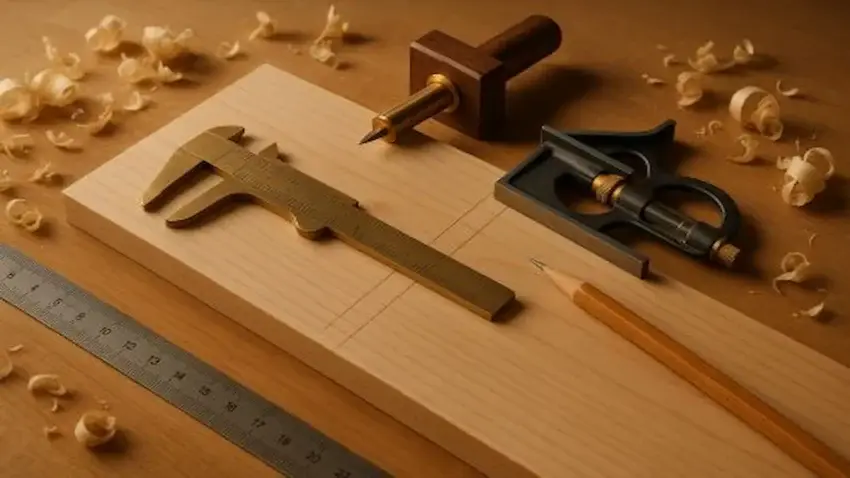
Precision Measuring Tools For Expert Woodworking aren’t just “nice to have” —
they’re the backbone of clean joinery, tight fits, and furniture that actually sits square.
Even the best saw or chisel can’t save a project that was marked or measured wrong.
When you start relying on accurate calipers, reliable squares, and a solid marking gauge, your cuts get sharper, your joints get cleaner, and your confidence skyrockets with every piece you build.
Whether you’re laying out dovetails, checking board thickness, or dialing in perfect 90° angles, precision tools give your woodworking the accuracy and repeatability that separates beginners from true craftsmen.

⭐Suggested Tools & Measuring Gear You’ll Need
To get truly accurate results in woodworking, you need tools designed for precision.
These three essentials will help you mark, measure, and layout every project with confidence.
Each one plays a different role in keeping your cuts square, your joinery tight, and your work repeatable.
👉 Digital Calipers
Digital calipers give you ultra-precise measurements down to thousandths of an inch, making them perfect for checking board thickness, tenon sizes, dowel diameters, and tool setups.
The digital readout eliminates guesswork and ensures every cut or fit is exactly what you intended.
🌟 Amazon Product Suggestion:
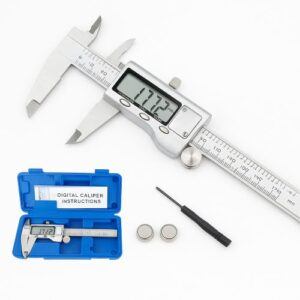
✔️ Jivarry Digital Caliper
(Stainless Steel, Large LCD, 6-Inch)
The Jivarry Digital Caliper is an affordable, accurate measuring tool that every woodworker should keep in their shop. With a smooth stainless-steel slide, a large easy-to-read LCD, and instant switching between inches, millimeters, and fractions, it makes precise measuring fast and frustration-free.
Perfect for checking board thickness, inside/outside dimensions, dowels, hardware sizing, and fine adjustments during joinery work.
Why it’s great:
✔️Large, clear digital display
✔️Switch between inch/mm/fractions instantly
✔️ Stainless steel body for smooth, accurate travel
✔️ Measures inside, outside, depth & step values
✔️Perfect for tight-tolerance woodworking and tool setup
✔️Comes with case, batteries & mini screwdriver
👉 Combination Square
A high-quality combination square is one of the most reliable layout tools in any shop.
Whether you’re checking 90° angles, marking consistent lines, or verifying board edges, a good square keeps everything aligned and accurate.
🌟 Amazon Product Suggestion:
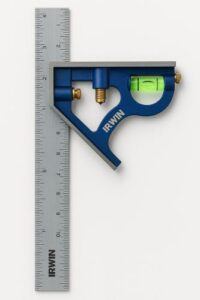
✔️IRWIN 12″ Combination Square
(Stainless Steel Precision for Any Build)
The IRWIN 12-inch Combination Square is a rock-solid layout tool that every woodworker should keep within arm’s reach. Its stainless steel blade gives you dead-accurate measurements, while the 45° and 90° reference faces make marking joinery, checking corners, and setting blade heights quick and foolproof. The durable blue cast-metal head grips the blade securely, and the built-in bubble level and scribe make it a multipurpose layout companion you’ll use on nearly every project.
Why It’s Great:
✔️Accurate stainless steel rule with easy-to-read markings
✔️90° and 45° faces for perfect layout and tool setup
✔️Solid build quality with a smooth-locking brass adjustment
✔️Integrated level vial + marking scribe
✔️Affordable, reliable, and ideal for beginners or pros
👉 Marking Gauge
A marking gauge gives you crisp, consistent layout lines that guide saws and chisels exactly where they need to go.
Unlike a pencil, it scores the wood fibers cleanly — which means better accuracy and tighter joints.
🌟 Amazon Product Suggestion:
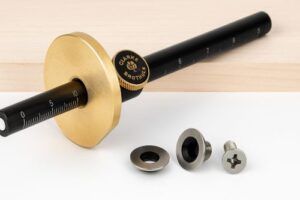
✔️ Clarke Brothers Wheel Marking Gauge
This brass-and-steel wheel marking gauge is a rock-solid layout tool built for clean, repeatable precision. The hardened cutting wheel leaves crisp lines with zero tear-out, making it perfect for dovetails, tenons, and any joinery where accuracy matters. The engraved inch and metric scale makes quick adjustments easy, and the knurled brass lock knob holds settings firmly so nothing slips mid-project. Comes with two replacement cutters, giving you long-term value for your shop.
Why It’s Great:
✔️ Solid brass head glides smoothly for consistent scoring
✔️ Hardened wheel cutter makes ultra-clean layout lines
✔️ Metric & imperial scale for fast, accurate adjustments
✔️ Includes two spare cutters for extended use
✔️ Perfect for joinery, repeat layouts, and fine woodworking projects
📏 Why Precision Measuring Matters in Woodworking
Accuracy isn’t optional in woodworking — it’s the foundation everything else stands on.
Even the slightest error in measurement can snowball into gaps in joinery, twisted assemblies, uneven tabletops, or parts that simply don’t fit.
Precision measuring tools remove the guesswork by giving you consistent, reliable reference points for every cut, angle, and layout line.
🪚 When your measurements are correct from the start, the entire build becomes smoother.
Your joints seat properly.
Your panels stay flat.
Your furniture sits level.
And you waste far less material trying to “fix” mistakes that didn’t need to happen.
📏 Essential Measuring Tools Every Woodworker Should Own
Every project, whether simple or advanced, starts with accurate layout.
And while you don’t need a shop full of high-end gear, a core set of precision tools makes your work dramatically better and far more enjoyable.
Here are the must-have measuring tools that form the backbone of accurate woodworking:
Digital Calipers for exact thickness, depth, and joinery sizing
Combination Square for perfectly repeatable 90° and 45° references
Marking Gauge for crisp, accurate layout lines
Steel Ruler for fast layout and verifying length
Marking Knife for clean, tear-out–free marks
Angle Finder for checking and matching odd angles
With these essentials at your side, you’ll eliminate most rookie mistakes
and get far more consistent results across every project you tackle.
⭐How to Use These Tools for Accurate Layout
Having precision tools is one thing — using them correctly is what unlocks real accuracy.
Each tool plays a specific role in marking, checking, and confirming your work before a single cut is made.
📏Digital Calipers:
Use them to verify exact thicknesses, dial in tenon cheeks, measure dowels, and confirm tool settings. Zero the calipers before each use and measure from multiple points for consistency.
📏Combination Square:
Slide the head to your needed measurement, lock it down, and use the square to transfer perfect 90° or 45° layout lines.
Always register the square firmly against the edge of your workpiece to avoid drift.
📏Marking Gauge:
Set the depth, lock the fence, and drag the gauge along the wood grain in one smooth pass.
The scribed line creates a physical groove that your chisel or saw naturally tracks into, improving accuracy.
👉👉 Used together, these tools give you dead-on references that keep cuts straight, joinery tight, and assemblies square — before you ever pick up a saw or chisel.
🪚 Common Measuring Mistakes and How to Avoid Them
Even with good tools, small habits can throw your accuracy off.
Most woodworkers don’t realize how easy it is to introduce tiny errors that later become big headaches during assembly.
A few simple adjustments can eliminate most of these problems.
✨Reading from the wrong edge:
Always confirm you’re starting from the correct reference point on your ruler or square —
Especially when switching between fractional and decimal tools.
✨Not registering the tool firmly:
If your square or gauge isn’t seated tightly against the workpiece, even a slight gap can skew your line. Take an extra second to feel it lock into place.
✨Using dull marking tools:
A dull pencil or knife makes fuzzy, inconsistent lines.
Keep your marking knife sharp and your pencils finely pointed.
✨Measuring twice… differently:
Measure from the same reference point every time.
Switching sides or flipping boards mid-layout can introduce hidden discrepancies.
👉👉 Avoiding these simple mistakes keeps your layouts clean, consistent, and trustworthy —
Which means fewer surprises as you build.
🎯 How to Maintain and Store Your Precision Tools
Accuracy depends on more than just good technique —
It also depends on keeping your tools in top condition.
Precision measuring tools are finely tuned instruments, and a little care goes a long way toward keeping them reliable.
👉 Keep blades and edges clean:
Dust, pitch, and grime can throw readings off.
Wipe down tools after each use to maintain smooth, accurate surfaces.
👉 Avoid dropping or banging them around:
Tools like digital calipers and combination squares can lose calibration if mishandled.
Treat them like you would treat a good chisel — with respect.
👉 Store tools in cases or padded drawers:
Hard impacts and temperature fluctuations can affect accuracy.
Use foam-lined drawers, hangers, or the original cases to keep them protected.
👉 Check zero and calibration regularly:
Digital calipers should always be zeroed before measuring.
Squares and gauges should be checked against known references from time to time.
👉👉 With just a little upkeep, your measuring tools will stay accurate for years —
and your woodworking will show it.
🧰 When to Upgrade Your Measuring Tools
Beginner tools can get you started, but as your woodworking skills grow, so does your need for greater accuracy and reliability.
Upgrading isn’t about buying fancy gear —
it’s about removing the limitations that hold your work back.
✨When your layout lines feel inconsistent:
If your square drifts, your calipers won’t stay zeroed, or your gauge doesn’t lock firmly, it’s time to level up.
✨When you start building higher-precision projects:
Dovetails, mortise-and-tenon joinery, flush inlays, and furniture builds all demand accuracy that cheap tools struggle to maintain.
✨When repeatability matters:
A good combination square or premium marking gauge gives you the same measurement every single time — no fuss, no recalculating.
✨When your tools slow you down:
If you constantly re-check your measurements because you don’t trust the tool, that’s the sign.
Precision tools should speed you up, not create doubt.
👉👉 Upgrading thoughtfully — one tool at a time — gives you tighter joinery, smoother assemblies, and a more enjoyable workflow overall.
📐 Final Thoughts…
Precision Measuring Tools For Expert Woodworking are the quiet heroes behind every clean joint and flawless build.
When your measurements are accurate, everything else just flows —
cuts line up, parts fit together, and your projects look like they were built with intention.
Investing in quality measuring tools isn’t about buying more gear…
It’s about removing frustration, eliminating guesswork, and giving yourself the confidence to build at a higher level.
🔧 Final Thoughts…
Precision Measuring Tools For Expert Woodworking are the quiet heroes behind every clean joint, every smooth transition, and every flawless build.
They don’t make noise, they don’t draw attention, but they make everything you do look
more intentional and more professional.
When your measurements are accurate, everything else just flows —
cuts line up, parts fit together, and your projects start to look like they came straight out of a master craftsman’s shop.
Good measuring tools save time, reduce do-overs, and keep frustration from creeping into your workspace.
Investing in quality measuring tools isn’t about buying more gear…
It’s about removing guesswork, boosting your confidence, and giving yourself the ability to build at a higher level. The more precise your measurements, the more your skills shine through —
And the more enjoyable every project becomes.
In the end, precision isn’t just a detail.
It’s the foundation of great woodworking.
 More Woodworking Projects You’ll Enjoy
Here are a few other beginner-friendly project ideas you can try next:
-
How to Build a Wooden Mailbox – A sturdy outdoor project that teaches accurate layout and assembly.
-
Build a Simple Wooden Toolbox – A classic beginner project and a great way to organize your tools.
-
DIY Display Case – Learn clean joinery with a project that looks great in any room.
-
Craft a Kids’ Stool in 5 Steps – A quick build that teaches essential cutting and measuring skills.
These projects help you grow your skills while creating something you’ll enjoy for years to come.
You got this!
 Craft it. Shape it. Own it!
 Need More Plans?
 Click here to learn more about Ted’s Woodworking Plans.
If you want access to hundreds of additional woodworking projects and detailed tutorials, check out my full review of Ted’s Woodworking Plans.
It’s packed with step-by-step builds that are perfect for weekend projects.

 Turn Your Woodworking Passion Into Income
Click here to learn more about Wealthy Affiliate.
SawdustSmarty.com started as a small hobby —
and it only grew once I finally learned how to build a real website.
If you’ve ever thought about turning woodworking into a side income, the training at Wealthy Affiliate is what I personally recommend.
